
People have asked about the Nature Reliance School logo for years.
Why a long knife?
Why an American chestnut leaf?
What do those two things have to do with wilderness survival, bushcraft, outdoor education, or the work we do today?
The answer goes back to the earliest days of Nature Reliance School. Some version of this emblem has represented the school since 2006. The design has changed and improved over the years, but the meaning behind it has remained remarkably consistent.
The knife and the leaf are not decorations.
They represent how we believe people should learn, work, and carry themselves in the natural world.
The Origins of the Nature Reliance School Logo
The current Nature Reliance School logo began taking shape around 2009.
At the time, the school was growing. What had begun with friends asking me to teach outdoor safety and wilderness skills was gradually becoming something larger. More people were attending courses. Our subjects were expanding. We were becoming clearer about what Nature Reliance School was and what we wanted it to become.
I worked with a professional graphic designer to refine the logo and bring those ideas together.
We did not begin by asking what looked trendy.
We asked what mattered.
What symbols reflected the history behind the skills we teach? What represented useful knowledge, responsibility, nature, and self-reliance? What would still mean something years after a design trend had disappeared?
We eventually brought two symbols together: a longhunter-style knife and the leaf of the American chestnut tree.
Why the Logo Includes a Long Knife
A Tool That Represents Practical Skill
The long knife in the Nature Reliance School logo was inspired by the tools carried by early longhunters and frontiersmen.
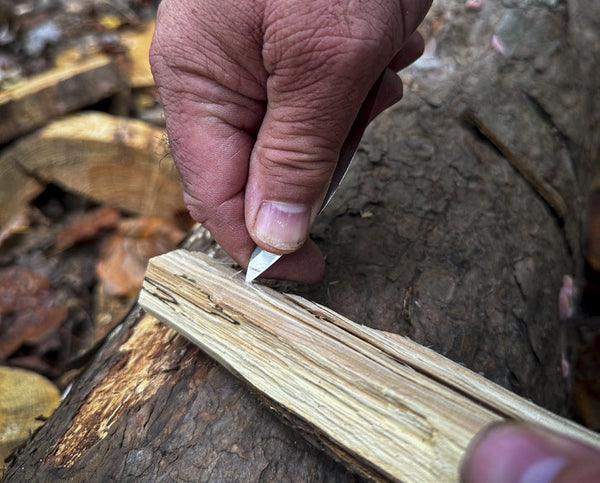
Those men traveled for extended periods through remote country. Their knives were not accessories. They were working tools used for processing food, maintaining equipment, preparing firewood, building useful items, processing game, fighting, and handling the ordinary jobs that had to be completed every day.
That practical value still matters.
I have spent decades teaching people how to use knives safely and effectively in the outdoors. I have also spent extended trips in the wilderness depending heavily on a knife. Those experiences have continually reinforced one lesson, the value of a tool is not found in owning it.
The value is found in knowing how to use it.
A person can own an expensive knife and still be careless, inefficient, or unprepared. Another person can carry a simple, well-maintained knife and accomplish a great deal because they have practiced with it.
The knife in our logo represents:
- Practical skill
- Adaptability
- Personal responsibility
- Useful tools
- Knowledge earned through practice
It also serves as a reminder that gear should support competence, not replace it.
History Deserves a Vote
Traditional wilderness skills did not appear on social media or in modern survival manuals. People developed them through generations of observation, work, mistakes, and necessity.
We do not believe every old method is automatically better. We use modern equipment and current information whenever they improve safety or performance.
However, history deserves a vote.
The people who lived and traveled in wild places before us learned valuable lessons about tools, weather, water, plants, animals, terrain, and human limitations. Ignoring all of that simply because we have newer equipment would be foolish.
The long knife connects our current training to that older body of field knowledge.
Why the Logo Includes an American Chestnut Leaf
A Tree That Once Defined the Eastern Forest
The American chestnut was once one of the dominant trees of the eastern North American forest.
It provided food for wildlife and people. Its wood was useful, durable, and widely used. In many places, the tree was woven into the daily life of the people who lived around it.
Then chestnut blight spread through the forests during the early twentieth century. Within a relatively short period, the American chestnut nearly disappeared from the landscape it had helped define.
A small number of native trees and surviving sprouts remain. Restoration work continues, but the tree’s story remains one of the clearest examples of how quickly something important can be lost.
A Symbol of Resilience and Stewardship
The chestnut leaf reminds us that nature is resilient, but it is not invincible.
That distinction matters.
People sometimes speak about the natural world as though it will simply repair whatever we do to it. Nature can recover from a great deal, but recovery is not guaranteed. Species disappear. Habitats change. Knowledge is forgotten. Skills that once passed naturally between generations can vanish when nobody takes responsibility for teaching them.
The American chestnut leaf represents:
- Resilience
- Stewardship
- Awareness
- Respect for natural systems
- The responsibility to preserve useful knowledge
It reminds us to pay attention while there is still something left to protect.
Where Practical Meets Natural
When the long knife and chestnut leaf are placed together, they explain a great deal about Nature Reliance School.
One represents the practical.
The other represents the natural.
That relationship helped shape one of our guiding phrases:
Where Practical Meets Natural.
We teach modern wilderness survival, land navigation, tracking, bushcraft, natural history, outdoor safety, leadership, and preparedness. We use GPS technology, modern water filters, current medical practices, and reliable equipment.
We also teach people to observe the terrain, recognize changing weather, understand plants and animals, how to flintknap, read tracks and sign, use a map and compass, and work with the materials available around them.
Those approaches are not in competition.
The best answer is often found by understanding both.
What the Logo Says About Outdoor Education
Skills Must Be Practiced in Real Conditions
Outdoor education cannot remain entirely behind a desk or on a screen.
A person can read about fire building without ever learning how wet wood behaves. They can watch a land navigation video without experiencing how terrain affects movement. They can study shelter construction without discovering that their chosen location collects cold air or runoff.
Information matters.
Experience tests it.
That is why our courses place students in forests, fields, hills, waterways, and changing weather. Real conditions reveal whether a technique works and whether a person can make useful decisions when things do not go according to plan.
Online learning can provide excellent instruction and preparation. It can teach principles, demonstrate techniques, and help students understand what to practice.
Eventually, though, the work has to leave the screen.
That belief is captured in another phrase that has become central to Nature Reliance School:
The best classroom has no walls.
More Than Wilderness Survival Skills
Nature Reliance School teaches practical outdoor skills, but those skills are not the final destination.
They are the path.
Learning how to navigate develops more than compass knowledge. It develops judgment.
Learning how to build a fire in difficult weather develops more than firecraft. It develops patience and adaptability.
Learning how to identify plants develops more than identification skills. It teaches observation and stewardship.
Working through an outdoor problem with other people teaches communication, humility, responsibility, and leadership.
The wilderness gives honest feedback. It does not care about our intentions, our equipment budget, or how experienced we claim to be. It responds to our preparation and our decisions.
That honesty is one of its greatest lessons.
What the Nature Reliance School Logo Means Today
The Nature Reliance School logo has been with us in some form since 2006.
During that time, we have taught families, civilians, instructors, first responders, military units, and people who simply wanted to become more comfortable and capable outdoors.
The subjects have expanded. The equipment has improved. Our understanding has grown.
The knife and leaf still fit.
The knife reminds us to practice useful skills, maintain our tools, and accept responsibility for our own preparation.
The chestnut leaf reminds us to observe, protect, and remain humble about our place in the natural world.
Together, they represent an approach to outdoor education grounded in reality, history, stewardship, and competence.
That is the story behind the Nature Reliance School logo.
It is where practical skill meets natural wisdom.
And where the best classroom still has no walls.